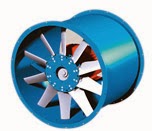
Hi' Air Movement: A HVAC Moment: Winds of Change.
The selection of appropriate equipment is essential to improving air movement.

The importance of air movement in the buildings of the GCC cannot be understated. It is debatable whether this region would have flourished as it has done in recent decades without it.
The provision of fresh and cool air to the structures in which we live, work and play has made the region a much more habitable place, especially in the scorching extremes of summer.
The existence of this fundamental MARKET demand has, of course, made the region a happy hunting ground for many local and global players in the MEP and HVAC industries,but the fecundity of the market has also increased competition, spurred innovation and changed the expectations of the air-conditioned masses.
No longer will stepping in out of the heat to feel a cool breeze suffice. End-users now demand maximum comfort.
“Air movement can provide desirable cooling in ‘warm’ conditions, but it can also increase the risk of unacceptable cool draughts,”
.jpg)
explains Hassan Sultan, director of mechanical department at MZ & Partners and former president of the ASHRAE Qatar Oryx Chapter.
“Noticeable air velocities can be perceived as providing freshness and pleasantness to the breathing air, but they may also be perceived as annoying. HVAC DESIGN innovations, energy conservation concerns, and new laboratory data on draughts have brought substantial attention to the issue of acceptable levels of air movement in the comfort standards.
“Air movement is one of the six main variables affecting human thermal comfort,”
Sultan continues,
“which is the main goal of HVAC SYSTEM design and execution in buildings, especially in the Gulf region. The other five are air temperature, mean radiant temperature, relative humidity, metabolic rate and clothing insulation,” he adds.
.jpg)
With some of these variables obviously beyond the control of HVAC SYSTEM designers, their ability to harness air movement takes on even greater significance.
The consequence of failing to achieve this can be a headache for an end-user, client/owner, and at least one member of the consultant-contractor team that delivered the system.
“Poor design and selection of air distribution terminals leads to draughts in some areas, stagnation in others, cold and hot spots and excessive noise – all these conditions have a bad effect on the well being and performance of the occupants,”
explains Raef Hammoudeh, head of mechanical engineering for KEO’s design division in the UAE.
Looking at such problems in the GCC’s building stock, Hammoudeh says that part of the issue is to do with a misguided focus or lack of attention from mechanical engineers as to what is really important in HVAC SYSTEM design.
“In the majority of projects, design engineers and contractors tend to concentrate their efforts on the provision of the chillers, air handling units (AHUs), ductwork and so on, and very little time or design effort on ensuring that the air distribution systems within buildings are selected to provide optimum distribution within the spaces or to ensure the thermal well being of occupants,” he says.
fzal Basheer, senior mechanical engineer at Two Fold United Electrical and Mechanical Contracting, SHARES Hammoudeh’s dissatisfaction with the regional industry’s approach and believes that failures at the early design stages are often responsible for failure of installations themselves.
“[The potential for air movement problems] needs to be addressed before the actual installation of the system,” says Basheer.
.jpg)
“It is not only the building services systems, in terms of additional HVAC units or additional power requirements, that need to be addressed. If additional plant equipment is required, plant room or ceiling space must be available.
If the equipment in the plant room needs to reach the required zone, slab openings or shafts must be available, which might not have been ACCOUNTED for at the design stage.”
Another piece of advice Basheer offers to system designers relates to the common air movement problem of odour circulation, which he says can be achieved by electrostatic precipitates and activated carbon AIR PURIFIERS.
“Consultants and clients need to make this mandatory by outlining it in the employer’s requirements and consultant design drawings,” says Basheer.
“What can be seen in several instances in the region is that if they have not been shown in the contract documents, the contractor doesn't install the odour management systems. Later on, if due to the foul smell the contractor is asked to come back to install the same, more often than not what is installed is more or less a quick fix due to spatial constraints and other design constraints that had not been ACCOUNTED for earlier.”
A more fundamental criticism of those in the region responsible for designing its HVAC SYSTEMS and delivering optimum air movement comes from Khalid A. AlMulhim, Saudi Arabian ASHRAE Chapter officer and HVAC/utilities engineering consultant at Saudi Aramco.
“Designers are not aware of the latest ASHRAE and other industrial related standards,” he says. “They lack knowledge in the minimum requirements for different applications such as OFFICE buildings, hospitals, malls, laboratories, libraries, worship places, airports, computer centres, restaurants etc.
"They do not comply with minimum ASHRAE standard requirements in design, selection, installation and COMMISSIONING. This will lead to many technical issues, including but not limited to the system performance, commissioning, start up, maintenance and client satisfaction etc. If things are done right from the first step, everyone will save time and money.”
To address this gap in technical knowledge AlMulhim encourages the industry to push for widespread training to familiarise designers, as well as contractors and clients, with the latest industrial and international standards such as those of ASHRAE, the Air Movement and Control Association International (AMCA), the Associated Air Balance Council (AABC), the National Environmental Balancing Bureau (NEBB) and the SHEET METAL and Air Conditioning Contractors’ National Association.
Nevertheless, KEO’s Rammoudeh suggests that standards of HVAC design and installation are slowly improving, due in part, he says, to the efforts of some of the larger consultants and contractors to deliver HVAC SYSTEMS in accordance with recognised standards such as the Chartered Institution of Building Services Engineers (CIBSE), ASHRAE and Building Services Research and Information Association (BSRIA).
On a more local basis, he also cites the growing influence of Abu Dhabi’s Estidama sustainable design rating and the increased interest in Leadership in Energy and Environmental Design (LEED) in the UAE, both of which stipulate standards for internal air quality.
Notwithstanding the value of such standards to maximising the control of air movement, AlMulhim accepts that there may be a case for more bespoke regional ASHRAE standards given the distinctive climatic conditions experienced in the GCC.
“The ASHRAE standards related to air movement are largely sufficient for the Middle East environment,” he says.
“However, special attention should be given during design to building infiltration, ventilation and AIR FILTRATION in order to overcome our harsh, hot, dusty and humid environment. So building infiltration, ventilation and filtration design standard requirements may need to be developed for our HVAC systems in the region. In addition, preventive maintenance programmes for HVAC systems are neglected in our region, where best practices and guidelines for these need to be developed as well.”
Two Fold Contracting’s Basheer is another advocate for more targeted regional HVAC standards, particularly for contractor’s handling of ducting.
“In the GCC, there is no stringent building codes for duct installations as there are no supervisory authorities like we have for power services and water services,” he says.
“Most GCC building codes fail to address air flow for comfort cooling. A duct system with terrible air flow can pass code inspection in several cities, and probably countries, as long as it is properly sealed and insulated.
Too many contractors assume that as long as the JOB passes consultant or client inspection, it must be a good duct system. It is important to realise that when we depend on visual inspections to set the benchmark for good and bad, we are building to the lowest level allowed rather than the highest possible quality.”
Meanwhile, Hammoudeh also highlights regional contractors’ failure to take a more active role in ensuring that the HVAC systems being installed here are capable of providing good INDOOR AIR QUALITY.
“They need to achieve this,” he suggests, “by making the correct sizing and selection of the entire air handling systems, installing the system in accordance with good standards that contribute to the proper cleaning, flushing, control, commissioning and adjustment.”
Moreover, AlMulhim makes the point that contractors are perhaps given too much leeway by some consultants when it comes to procurement, deviating from specifications for costly but high-quality air system components and selecting
“manufacturers that may not meet the industry codes, standards and certifications that have been specified in the construction documents”.
AlMulhim also raises the issue of contractor execution and delivery. “There is a lack of quality workmanship among some local contractors.
They have a limited understanding of the importance of work quality on the site and complete the construction without implementing the standards that are defined in the construction documents as a minimum mandatory requirement to govern the installation of air movement and HVAC SYSTEMS,” he says.
If this delivery of design problem can be resolved, then it will be to the system designers themselves to push the industry forward in the quest for complete air movement control.
KEO’s Hammoudeh says that at the upper end of modern HVAC DESIGN and the technology, there is no lack of fresh thinking being applied to the problem.
“New HVAC systems designs are using energy efficient, VARIABLE SPEED MOTOR technology for fans and pumps,” he explains.
“They use energy recovery HEAT EXCHANGERS between the supply and extract air streams, amd variable air volume (VAV) air distribution terminals to match the ventilation and cooling provided to each space with the requirements of that space.
Supply and extract air volumes are adjusted in tandem to maintain the pressure regime in the zone using sophisticated automated controls.
Other COOLING SYSTEMS are also being introduced into the region such as underfloor cooling, radiant panel cooling and displacement ventilation.
Furthermore, consultants are now are working more closely with manufacturers to ensure the equipment selections adhere to and compliment the design intent for the system.”
AlMulhim is slightly less enthusiastic about the work being done in regional HVAC design, particularly to advance thermal comfort in the Middle East, saying that thinking is often limited to VAV and VARIABLE FREQUENCY DRIVE (VRD) systems, as well as advanced temperature and pressure controls. However, he does highlight some “new innovation” taking place in induction low temperature air diffusers.
The importance of diffusers’ role in controlling air movement is something MZ & Partners’ Sultan also underlines.
He encourages greater collaboration between the decision-makers in this area and a more considered approach before decisions are made.
“The design must include an adequate supply of ventilation air to the breathing zone of the space and a proper selection of diffusers,” says Sultan.
“As the choice of diffusers is based on the mechanical engineers and architect, both the engineer and the architect need to work together to make the final selection.
In addition, the ideal selection is dependent on the type and operation of the air supply to the diffuser. Calculation of the air quantity required by the space and the proper diffuser selection, location, and design is one of the important issues concerning air movement.”
Finally, too often overlooked on too many projects, AlMulhim emphasises how a revised approach to COMMISSIONING could go a long way to addressing the region’s problems with air movement.
“COMMISSIONING is very important to minimise the potential for air movement problems,” he says.
“The COMMISSIONING process should start early from the design stage of the project, all the way to the start up and handover of the project.
A certified commissioning expert should be involved during the design to verify each element of it and the latest standard requirements needed and to enforce and implement the requirements on the construction site.
“The commissioning process task should be stated in detail as part of the construction documents by the project consultant.
This will help the contractor to implement and complete the project while considering all the technical and standard requirements without any technical obstacles or performance difficulties during start up and operation of the HVAC SYSTEM.”
Given the long standing careless attitude to commissioning in the region, AlMulhim’s suggestion may be wishful thinking, but it is perhaps a point that needs repeating enough times by those of influence in the industry before clients, consultants and contractors across the region take it on board.
HVAC SYSTEMS designers and installers can be as good as they come, but if a system is not taken through a prolonged and detailed testing and commissioning programme, then all of that brilliant design and installation work may be for naught.
The end result: uncomfortable, dissatisfied occupants airing their HVAC grievances to landlords and building owners, all putting a stain on the consultant and contractor’s name with each complaint.






.jpg)
 .
. 






.jpg)