Showing posts with label fan. Show all posts

14 Mar 2014

Hi E Community Event! Hi At Beijing!


 Click Here Or Image To View CRH 2014 Exhibition Homepage Direct Link.
 Click Here Or Image To View CRH 2014 Exhibition Homepage Direct Link. 

Hi Visit Or Exhibit! Hi Beijing! Hi Exhibition! Hi China!


Initiated in the year of 1987, the International Exhibition for Refrigeration, Air-conditioning, Heating and Ventilation, Frozen Food Processing, Packaging and Storage (China Refrigeration Expo) has been reputed as one of the leading exhibitions you can't miss in HVAC&R industry for its over 20 years persistent improvement and innovation. 

This exhibition is organized by China Council for the Promotion of International Trade, Beijing Sub-council, Chinese Association of Refrigeration, China Refrigeration and Air-conditioning Industry Association, and has been certificated by the International Association of Exhibition Industry (UFI) and Foreign Commercial Service of Department of Commerce U.S. (US FCS).

Visit CRH 2014 Exhibition Homepage For More Downloads Click Here Or Image Above. 
Hi Exhibitors; Hammam Industries & Co. Egypt. 

Download The Official Exhibition; Reservation Form for CR2014. Click Here. 
Download The Show Express 2012 3th Edition . Click Here. 


Hi E Community Event! Hi At Beijing! 
Beijing CHR 2014

 Click Here Or Image To View CHR 2014 Exhibition Homepage.
Click Link Here or Image Above To Visit CRH 2014 Exhibition Homepage Link. 


An Hi Focal; Exhibition Overseas Partner;

 Click here to visit AMCA Certified Product Homepage.
Click here or image above to Visit AMCA Product Certified Homepage & To View AMCA Industry Codes / Standards.
Hi E Community Blog Announcement On Hammam Industries & Co. Highlight At Hi Focal Exhibition Point At Beijing! 

 Click Image To Visit CTI Certified Product Range & View MESAN Group Certified Range.
Click Image Above or Click Here To View CTI Certified Homepage For MESAN Group Cooling Towers & Directory Search. 
 Click Image Here To View Hammam Industries & Co. Sample of Projects. Click Image To  View Hammam Industries & Co. AMCA Certified Range.  Click Image To  View Hammam Industries & Co. AMCA Certified Range.
 Click Image To Visit CRH 2014 Website.
Click here or image above to visit CRH 2014 Website.

Visit Hammam Industries & Co. Egypt, Beijing CRH 2014

 Click Image To Visit MESAN Group Homepage.
Click here or image above to visit MESAN Group Homepage Link. 
 Click Image To Visit Hammam Industries & Co. MESAN Group CTI Certified Cooling Towers Range.
Click image above or here to visit Hammam Industries & Co. MESAN Group CTI Certified Product Range Available In Egypt. 
 Click Image To Visit Hammam Industries & Co. Website.
Click image above or here to visit Hammam Industries & Co. Homepage. 

Hi Growing Products; View Hammam Industries & Co. Available Smoke Exhaust Selection Certified Range .
 Click Here Or Image To Visit Hammam Industries & Co. Smoke Exhaust Range Of Products.
Visit Hammam Industries & Co. Smoke Exhaust Product Range & Much More Click The Homepage Link Here Or Image Above. 
 Click Image To View Hammam Industries & Co. Homepage For GT Fan Product Catalogue.
Hammam Industries & Co. GT Smoke Exhaust Series Visit Homepage Link To View & Download Product Catalogue.
 Click Here Or Image To View CRH 2014 Exhibition Homepage.
Click Image Above Or Link Here To Visit CRH 2014 Exhibition Homepage. 
An Hi Focal; Exhibition Overseas Partner;
 Click Here Or Image To View ASHRAE Homepage Link.
Click Link Here Or Image Above To View ASHRAE Homepage Link. 

8 Mar 2014

Hi Weeks Asked Bobble!

Hi Weeks Asked Bobble!


Hi Before We Ask! Whats A Bobble? Lets Introduce What's Made Us Bobble In The Industry This Week!

Hi Topic: Test Block In AMCA Standard!

Hi Issue: AMCA specifies the term "Test block" as a design point of fan.

Hi Question: Please advise the meaning of this "Block".


Hi Meaning: 

- "In addition to the fundamental volume specifications, combustion process fans, particularly larger fans, are often specified for two conditions . . . actual and test block.

The actual condition is the calculated volume (including excess air) and pressure requirements. 

The test block condition is a theoretical duty that includes some safety factor beyond the actual volume and pressure requirements. 


The fan selection for the application should be capable of meeting both conditions with good efficiency, economy, and stability. 

Whenever possible, the actual condition should represent the most efficient point of operation for the fan selected for the application. "

 Click Here To Visit AMCA Website.
Click link here or image above to visit AMCA Homepage. 

30 Nov 2013

Hi Sustainable Development in Industrial Ventilation


Sustainable Development in Industrial Ventilation


The best route to sustainable development in industrial ventilation, dust extraction and waste extraction is through the design of the system. Moving air requires energy. Heating air requires energy. In both cases the potential to save energy over a prolonged period through good design exceeds that from other current efficiency developments. Key points of design include:
  • The air volume
  • Fan efficiency and motor control
  • Heat recovery and air make-up
  • Training and maintenance

Air volume:


The broad spectrum of industrial ventilation and process extraction requirements means that a simple solution to sustainable development is not possible as, for the most part, each system is a bespoke design for the specific application. However, optimizing the air volume in each design is without doubt one of the best. Why?
  • Air volume is directly proportional to power
  • 10% less air means 10% less energy
How is this achieved? Often through the design of the hood, the position relative to the emission source and how much that source is enclosed.


The hood designs in the diagram above represent concepts as there will often be limitations on how far this design philosophy can be followed. However, it is clear to see that the position of the hood relative to the emission source and changing to an enclosure hood design, where practicable, could reduce the required extraction air volume significantly.

Fan efficiency:


The range of fans used across the application of ventilation and process extraction systems being typically considered could have efficiency from 50% to 80%. The fan efficiency compares the input energy to the work done and has a significant impact on energy consumption, for example,
  • 40,000 hours operation broadly equates to 5-years @ 24/7 or 10-years @ 16 hours 5 days per week.
Based on 25kW aerodynamic energy requirement and an energy cost of 10p/kWh
  • A 50% efficiency fan would consume 50kW/h, at a cost of £200,000.00
  • A 75% efficiency fan would consume 33.3kW/h, at a cost of £133,200.00
If this is compared to the stated difference in efficiency between IE3, IE2 and IE1 motors of around 1.5-2%, at these motor ratings, then notwithstanding the possibly increased capital cost of selecting a higher efficiency fan, the energy savings through the 40,000 hour life cycle are vastly more significant than the initial costs. For more information on these motor standards, look up "Premium efficiency" on Wikipedia.

Motor control:


A related aspect to consider is the motor control where further energy saving possibilities exists although often not through the widely promoted speed or frequency inverter control.
In the first instance it is necessary to appreciate the laws of physics which apply to fans once installed in a system, assuming there are no changes to the ducting design.
  • A 10% increase in the fan speed increases the volumetric airflow by 10%; however it requires a 33% increase in electrical power.
  • Conversely, a 10% reduction in the fan speed reduces the airflow by 10% and reduces the electrical power by 27%. Just 5% speed reduction reduces the power by 14% so the savings through speed optimization can be significant.
However, a fan only absorbs the power required to do the work so, reducing the speed by 10% through a change in the drive belts may provide the saving at a modest investment. And as the power and motor size increase the savings become disproportionately greater.
% fan speed80%90%100%110%
% motor load kW51%73%100%133%
Table of motor power change with fan speed change
Example
  • 37kW motor installed
  • 32kW absorbed by the fan
  • Energy cost per annum, 24/7 operation, is £27,955 @ 10p/kWh.
  • Energy cost per annum, 16/5 operation, is £13,312
  • 10% speed reduction means absorbed power becomes 24kW
  • Assuming new drive belts and labour costs £500 (renewed annually anyway)
  • Then first year net saving at 24/7 operation is circa £7,000, then £7,500
  • And first year saving at 16/5 operation is circa £3,000, then £3,500.
Of course this is only applicable to a fan with a drive belt system fitted. An inverter controller will do the same, although the installation would cost more and an older motor may not be suitable for frequency variation control.
It should be noted there are certain advantages in using an inverter over the simple drive belt option including:
  • Applicable to all fans; direct drive or belt drive
  • Further speed change adjustments are easily made
  • Little loss in motor efficiency at reduced speeds, whereas reduced power at unchanged motor speeds may reduce the motor efficiency
  • Fan speed reduction is limited to reducing the rated motor power by 50%, when other factors may come into play
  • Applications with frequent start/stop cycles
In designing an extraction system, it is prudent and not untypical to err on the side of caution and allow for a modest increase in airflow and hence fan speed on completion of the installation, which would have an impact on the power required, and to select a motor one size above the bare minimum required. However, once installed and commissioned at the correct speed, the load on the motor may be some way below the motor duty, although only drawing the proportionate electrical current. Often a case is made for inverters based on the installed power rather than absorbed power of the fan motor. It is fairly simple for an electrical engineer to measure the running current of the motor compared to the motor rated full load current (FLC) to provide an indication of the energy being used.

Air input:


Exhausted air must be replenished either uncontrolled through egress into the building or controlled through an air make-up supply. Whenever the external temperature is below the required internal level, heat energy will also be required. Whether or not the air entering is controlled or not is often dependant on the building size and relative amount of extracted air. As an example, 70kW of heat energy would be required for a 20OC temperature rise in 10,000m3/h and with a 5p/kWh heat energy, could cost around £10,000 per annum on a 24/7 operation.
More sustainable approaches to air make-up include controlled introduction which reduces draughts and may, in some instances, lessen the heat load required. Re-using exhausted and filtered air will have an operational cost however often shows a payback within two to three years. Although less efficient than returning filtered air, heat exchangers may also enable the re-use of exhausted heat energy when filtering in impracticable. Sources of "free" heat should also be considered, compressors and hot process areas being valuable sources on occasion.
Once into operation the levels of training and maintenance can have an impact on wasted energy, environmental emissions or waste materials requiring landfill disposal.
The main objective under these headings is achieving optimum performance. By definition energy, emissions and waste are then controlled. It is a difficult position to reach and maintain. As ventilation and process extraction, (dust or waste), provide secondary or support roles to the principle production process all too often they get a lesser level of training and maintenance. Performance may decline gradually over time and often goes unnoticed with some examples including:
  • Incorrect low compressed air pressure or cleaning control settings resulting in lower filter cleaning efficiency. This increases pressure drop and hence the absorbed motor power, and may reduce extraction efficiency.
  • Incorrect high compressed air pressure resulting in "puffing"- dust passing through the filter bags due to over-cleaning which increases the carry-over emissions and reduces the life of the filter bags through fatigue during the cleaning process.
  • Incorrect fan belt drive adjustment leading to a loss of fan speed which could lead to lost production through a build-up in the ducting or lower efficiency in the extraction and a reduction in the control measure. Complying with COSHH/LEV guidelines may help to identify this, however with 14 month intervals there is a risk of long term deficiency.
  • Operators using equipment in an unintended manner is all too frequent and often goes unrecognised. When this situation occurs, performance as a control measure, emissions to atmosphere and an increase in energy consumption may easily result.
In conclusion, sustainable developments in industrial ventilation and process extraction applications are not only achievable but may be quite significant because they are based on good system understanding, design and use. Interestingly many recent developments in energy efficiency are over shadowed by the improvements which may be possible through design, equipment selection and an on-going user training and maintenance programme. It is clear that any low cost installation advantage may be far from the lowest overall cost and soon offset as running and service costs are included over a modest period of time. Also, when using and maintaining the system as intended, the safety and protection provided will be optimised.


4 Oct 2013

Hi Noise Reduction Innovation For Power Stations

Hi Aerodynamic noise control innovation technology;
New technology deployed at the largest US biomass power plant prevents creation of noise from fans while reducing power consumption.

The solution developed by the Industrial Noise and Vibration Center (INVC) from Berkshire, UK, relies on active noise reduction instead of suppressing the noise by silencers and acoustic enclosures.
“We have developed a way to prevent the noise being generated in the first place instead by designing aerodynamic inserts that fit inside the fan casing. You can think of these as akin to the aerodynamic features used on Formula 1 cars to control airflow,” said Peter Wilson, the INVC technical director.
The technology was installed at the 50 MW Schiller biomass power plant in New Hampshire - the largest biomass power plant in the US. The site had had problems due to the noise produced by the station’s ID fan. The installation itself only required 12 hours. According to a technical review evaluating the solution, not only noise reduction has been achieved but the plant  has also been consuming considerably less energy.
"We recorded a 10dB drop in noise, which is huge. We also recorded a reduction in the power used by the ID fan after Quiet Fan technology had been installed." said Jim Granger, the Senior Engineer at Schiller.
Conventional silencing technology to suppress the drone of large ID fans is rather costly and increases down-time of the installation. According to the evaluation data, the Quit Fan technology managed to achieve similar level of noise reduction costing about 80 per cent less.

How does the fan noise attenuating technology work?
A similar approach to that of the way that Formula 1 teams invest in the design of aerodynamic aids to control the airflow round their cars. As fan noise is the sum of the turbulence generated pressure fluctuations in the air shed by the blades, we have developed a range of aerodynamic inserts that are fitted inside the fan casing to smooth the flow. This reduces the pressure fluctuations – and hence the noise – at source without introducing the back-pressure often associated with silencers. This not only reduces the noise travelling down the intake and exhaust duct-work  but also that passing through the fan casing which may not only eliminate the need for silencers, but also the need for acoustic enclosures.

HVAC – Chiller – Condenser – Cooling Tower Noise Reduction:

Innovative new techniques developed to control the noise from HVAC and chiller / condenser systems without compromising efficiency. These typically provide around 10dB of additional attenuation compared with conventional noise reduction packages and silencers – and at a fraction of the cost.

Visit INVC Website for further information and to view case studies on noise reduction innovations.

6 Oct 2012

Hi AMCA Fan Efficiency Grade's (FEG's) Green Seal Announcement!.

Hi AMCA Fan Efficiency Grade's (FEG's) Green Seal Announcement!.

The following information was released by the Air Movement and Control Association International, Inc. (AMCA):

The Air Movement and Control Association International, Inc. (AMCA International) has recently revised its Publication 211-05, Certified Ratings Program - Product Rating Manual for Fan Air Performance to AMCA Publication 211-05 (Rev.3/11).

The revisions from March 2011 add requirements for certifying Fan Efficiency Grades (FEGs), revises the check test tolerance for Power, and clarifies how the check test tolerance is calculated in the absence of a catalogued free delivery airflow rate.

The new Fan Efficiency Grade program will support initiatives within many codes and standards that will encourage or require greater energy savings. Fan Efficiency Grades that are listed in approved electronic print catalogs may be accessed via a direct link from the AMCA International Directory of Licensed Products.

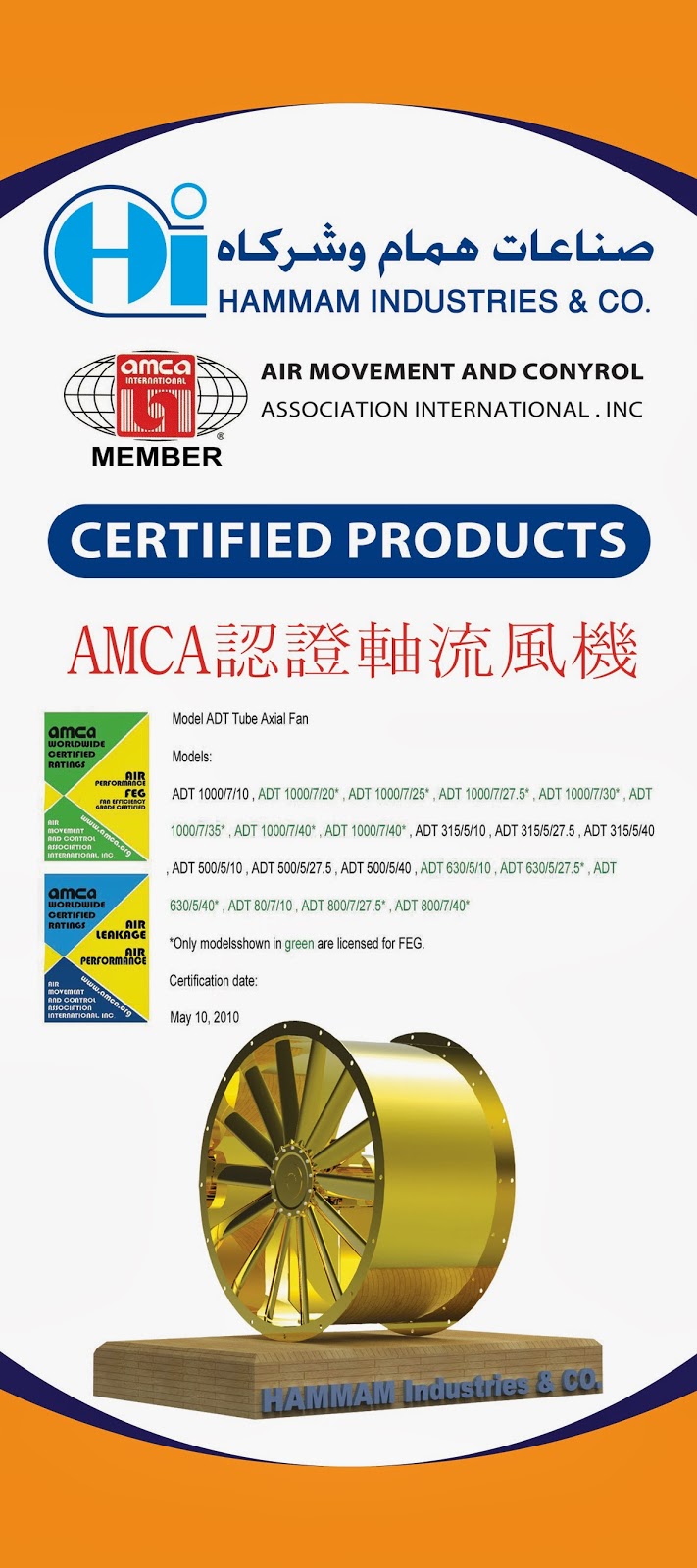
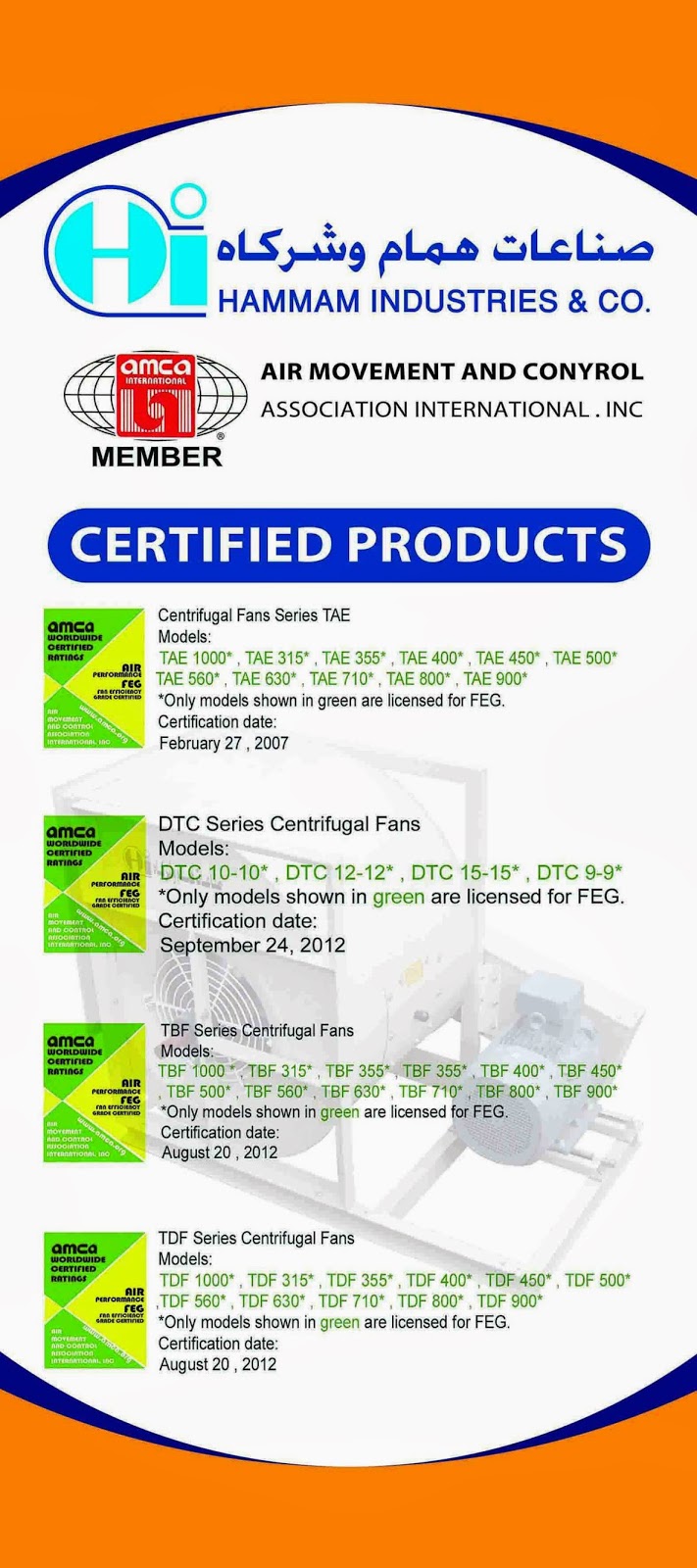
Hammam Industries & Co. has achieved AMCA Certification for Five Hammam Fan Series of Hammam Fan Products have Obtained the AMCA GREEN SEAL which certifies the fan efficiency grade FEG, in addition to Performance, Sound and Efficiency.

These are the HAMMAM: ADT; TAE; TDF; TBF; DTC series.


All fans have an FEG associated with their performance. It is a relatively simple process to obtain a certification of its FEG. To obtain the certification, the FEG rating must be published and the rating has to be verified by the AMCA International Staff. A form listing the models you desire to get FEG certified should be completed and sent with your proof catalog to the AMCA International headquarters for verification and to obtain a new license appendix.


If FEG ratings are the only catalog change, the catalog verification will completed at no charge. Please follow these guidelines.

The new "green" seal is now available for use with both approved electronic print catalogs (PDFs) and electronic selection softwares. Additionally, the new "green" seals purchased for application to product will be available after July 1, 2011.

The generic "FEG" seal can be used in a catalog when not all sizes in a licensed product line are "FEG" certified. If all sizes are "FEG" Certified, then either the "Sound, Air Performance and FEG" or "Air Performance and FEG" seals may be used in the catalog.

HAMMAM Industries & Co. Axial & Centrifugal FEG Certified Green Seal approved electronic print catalogues may be viewed at the link attachment provided.


The FEG certification is available for all fans that have a power input greater than 1 bhp, except air curtains, induced flow fans, energy recovery ventilators and positive pressure ventilators.

The purpose of the AMCA International Certified Ratings Program (CRP) provides the buyer, user and specifier assurance that the manufacturer's published performance ratings of air system components are reliable and accurate, and further, to provide these parties with information on how the product was tested, what appurtenances were included, and other pertinent information so that they may be able to select an air system component that will provide the performance required.


Hi Translate Linguistic Hi Proverb Tool.

(Hi) - Visit The New Digital World.

(Hi) - Visit The New Digital World.
As It Is Explained, Dismantled & Incorporated.

Ambient Air Quality Monitoring / Continuous Emissions Monitoring / Process Control / Data Handling.

Ambient Air Quality Monitoring / Continuous Emissions Monitoring / Process Control / Data Handling.
"Gas Monitoring Solutions"

Hi Air Pollution Engineering!.

Hi Regulations, Pollution Engineering!.

Hi Wikipedia Search.

Search results

Hi Bloggers Contact Form.

Name

Email *

Message *

Hi ' Graduate School at the Centre for Alternative Technology!.

Hi ' Graduate School at the Centre for Alternative Technology!.
"MSc Renewable Energy and the Built Environment."