Showing posts with label quality. Show all posts

8 Nov 2014

Hi Top Cities With the Worst Air in the United States.

Hi Top Cities With the Worst Air in the United States.


Dealing with poor air quality can be not only an annoyance, but hazardous to your health as well. Although there are places around the world that are much worse, there are still places in the United States that have poor air quality. Because of this, the residents suffer, dealing with the poor air quality sometimes every day of the year. Be aware of the cities that have the worst air quality, and learn how to best protect yourself if you reside in one of these cities.

Los Angeles:


There are close to eighteen million people living in and around the Los Angeles area. This includes Long Beach and Riverside. Because of these large number of people, industrial factories, cars, and shipping ports add a large amount of pollution. It doesn't help that there is not often weather changes such as high winds, rain or snow to clear everything out. Even though the air is heavily polluted, it is better than it had been in previous years. There have been efforts made to clean up the air, making it healthier for everyone in the area.

Phoenix:


With a smaller population, reaching about four million, the air is still heavily polluted. Although Arizona has been known for a long time as the perfect place for those with respiratory issues to come and relieve their lungs, the same cannot be said for the state's capital. Because of the way the city is situated, it makes it hard for the pollution to leave the area, causing it to settle. Those who already have problems with their lungs or heart should stay inside on bad air days and avoid exercising outside.

Hanford:


Although the population of Hanford, California is smaller than most cities that made the list for the greatest pollution, this town of 150 thousand people ranks in the top ten worst cities for pollution by ozone, year round pollution, and short term pollution. Those who live in this area should be aware of these potential dangers, and do what they can to protect themselves against the problem.

Bakersfield:


Bakersfield, California has ranked as the worst city as far as air quality goes many times, not necessarily because of the pollution, but because of the elements that are in the air. There is a lot of agriculture in this region, and when work is being done, fertilizer and pesticides used, and even dust is brought up into the air, creating a potentially harmful concoction to ingest.

Even if you don't live in one of these cities, you still have a potential of getting sick from pollutants in your area. To better protect yourself plan to carpool, stay inside on days with poor air quality, and ensure that the filter in your homes heating and air system is always in proper working order. The filter in your home is critical for many. It is the first line of defense in your home to create a safe environment against the pollution in the air. Take care of this to maintain your health in the best way possible.


!!!!AIR POLLUTION CALIFORNIA!!!

5 Nov 2014

Hi Global Market for U.S. Indoor Air Quality to Reach $11.4 Billion by 2019!.

Hi Global Market for U.S. Indoor Air Quality to Reach $11.4 Billion by 2019!.


BCC Research reveals in its new report, U.S. Indoor Air Quality Market, the U.S. indoor air quality (IAQ) market is expected to grow to $11.4 billion by 2019, with a compound annual growth rate (CAGR) of 7 percent over the next five years. The equipment segment market is anticipated to grow at a CAGR of 7.4 percent.


Since 2012, continuing media attention focused on the health effects of toxic mold, the outbreak of infectious diseases (such as bird flu), and the increase in chronic respiratory diseases such as asthma have resulted in a new interest in IAQ in homes, commercial buildings, schools and hospitals.


There is a distinct equipment market within the industry that includes products such as air-cleaning equipment, HVAC equipment, HVAC replacement filters and IAQ instrumentation. This market, which was valued at $3.9 billion in 2013, is predicted to reach nearly $4.1 billion in 2014 and $5.8 billion in 2019, with a projected CAGR of 7.4 percent.


Although the commercial segment was the largest market for IAQ equipment and services in 2013, the residential sector is projected to move into the top position by 2019, with 29 percent of the market, followed by commercial buildings (28 percent), healthcare (16 percent) and schools (14 percent).


“The U.S. economy has continued to recover from the 2008–2009 recession, boosting the market for IAQ equipment and services,” says BCC Research environment analyst, Andrew McWilliams. “The IAQ market is important because health problems such as building-related illness and sick-building syndrome, as well as other ailments associated with poor IAQ in homes, offices and schools, are on the rise in the U.S.”


U.S. INDOOR AIR QUALITY MARKET determines the size of the overall IAQ market and its subcategories, such as IAQ equipment and technologies, consulting services and environmental services.


7 Sept 2014

Hi' Tips to Improve Indoor Air Quality;

Hi' Tips to Improve Indoor Air Quality;


Indoor air pollution is considered as one of the top environmental risks to public health worldwide due to increasing number of building-related illnesses. 
Studies have found that concentration of indoor pollutants is significantly higher indoors than they are in outdoor environment, which is two to five times and sometimes hundred times higher than outdoor levels. 
As most of the people spend 80% to 90% of their lives indoor, indoor air quality has significant implication on sustainability.
Decreased indoor air quality can affect quality of life of the building occupant, increase health risks and increase the liability for building owner, decrease the productivity of occupants and reduce the resale value of the building. Poor indoor air quality can cause “sick building syndrome”, which is a medical condition linked to poor health and absenteeism.
Poor indoor air quality is due to many factors including but not limited to improper building design, inadequate ventilation, off-gassing of volatile organic compounds (VOCs) from furniture, carpets, paints and coatings, cleaning products, and from human respiration. Airborne particles such as lints, dust, dust mites, mold, bacteria, pollen and animal dander also contribute to poor indoor air quality. Indicators that are used to measure the indoor air quality include total particulate matter, total volatile organic compounds (TVOCs), formaldehyde, carbon dioxide (CO2), carbon monoxide (CO), ozone (O3), air temperature, relative humidity (RH). Concentration of CO2 in the indoor environment indicates whether ventilation is sufficient or not.

In the Middle East region, most of the people live in enclosed air-conditioned indoor environments. With rapidly growing population, increase in number of vehicles on the road, high temperature level, ever increasing construction activities, regular sandstorm, concentration of air contaminants in the region is among the highest worldwide. Indoor environment also reflects outdoor air quality and pollution. Transport of outdoor contaminants to the indoor environment can result in occupant exposure to outdoor pollutants that have serious health impacts. In addition, there are many sources of indoor pollutants present in building materials, cleaning products, indoor mold and legionella growth, and emission from interior furnishings, finishing and equipments.
Tips to Improve Indoor Air Quality;

Indoor air quality is influenced by concentration of outdoor air pollutants as well as indoor source of pollution, characteristic of building and habits of occupants. Appropriate building design and mechanical system and control strategies as well as changing occupant behaviour can improve indoor air quality and health and comfort, performance and productivity of building occupants. There are a host of strategies to improve the indoor air quality.
Appropriate design;

Building envelop, orientation, and location of air intake, location of mechanical ventilation systems can contribute to indoor air quality. Hence, these factors should be considered during the design stage of projects to control the main source of pollutants for the whole building.
Whole house mechanical ventilation;

Properly designed and sized ventilation system can supply adequate outdoor air to indoor. In most of the green building rating systems, industry standards such as ASHRAE Standard 62 or Ventilation for Acceptable Indoor Air Quality are commonly followed.
Mixed mode ventilation:

Use of combination of mechanical and natural ventilation systems in buildings, such as automated window controlling systems and operable windows, can help in maintaining healthy indoor air quality.
Air quality management during construction:

During the construction phase, molds can develop due to exposure of building materials with moisture. Dust and particulates can easily accumulate on building materials if they are not protected. The air quality during the construction period can be protected by protecting the building materials from dust and particles and moistures.
High efficiency air filters

Filters prevent transports of outdoor VOCs, dusts, particulates and ozone indoors. Use of good particle filter such as high MERV rated filters in ventilation equipment are found to be the most effective filters in filtering outdoor dust and particulates out.
Maintenance schedule for HVAC filters:

Dirty filter can cause sensory irritation. Hence, appropriate maintenance schedule can prevent this to happen.
Use of low emitting materials

Use of materials that have low VOC content for products such as indoor carpets, rubber flooring, sub-floor materials, ceramics and ties, plasterboards, or other sealants and adhesives.  Also internal construction materials with low formaldehyde content can be helpful.
Conduct building flush out

Flushing out of indoor contaminants thoroughly in buildings before occupancy will help replacing dirty indoor air with fresh outdoor air.
Green cleaning program:

Select cleaning materials that are made of low emitting materials and employ a green cleaning program to reduce contaminant exposure.
Carbon dioxide monitors: Install CO2 monitors in ventilation system and integrate them to regulate the supply of fresh air according to the building occupants demand. By doing so, if the CO2 concentration increases beyond a set point, then the airflow automatically increases. 

Sustainable Cities.

27 May 2014

Hi LEED vs. Green Globes: A Comparison!.

Hi LEED vs. Green Globes: A Comparison!.


24 Mar 2014

Hi ASHRAE GreenGuide

Hi ASHRAE GreenGuide
The Design, Construction, And Operation Of Sustainable Buildings.
 View Hammam Industries & Co. AMCA Certified Product Range.
Click Link Here To View AMCA Homepage For Certified Axial & Centrifugal Hammam Industries & Co. Egypt Product Range & Product Catalogue Download For Fan Efficiency Grade (Green Seal Label) & Much More...,

Download &/Or View - "Complete Green Building Guidance from Planning to Operation."

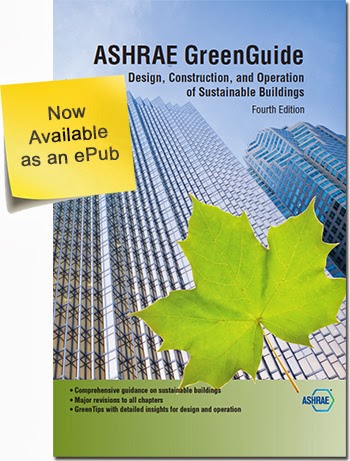
The newly published fourth edition of the ASHRAE GreenGuide contains updated guidance that reflects how green building practices as well as the industry have changed since the first edition was published in 2004.
Over the past decade, the industry has witnessed the continued evolution of green building programs have evolved from voluntary to more in the industry mainstream or mandatory, according to ASHRAE.
ASHRAE GreenGuide: Design, Construction, and Operation of Sustainable Buildings, 4th Edition, uses an integrated, building systems perspective to provide need-to-know information on what to do, where to turn, what to suggest, and how to interact with other members of the design team.
The guide contains several changes that will impact green building design.
First is a complete revision of the indoor environmental quality (IEQ) chapter with much of the content based on the Indoor Air Quality Guide: Best Practices for Design, Construction and Commissioning.
Another change is a new chapter on sustainable sites.
As in previous editions, the book contains Green Tips, or which are sidebars containing information on techniques, processes, measures or systems. There are 44 Green Tips in this edition, including new ones on topics such as condensing boilers, rain gardens, green roofs and data centers. 
 Click Image To Download Greenguide ASHRAE.
Click Link Here To Download &/Or View ASHRAE Greenguide. 
Whether you are an HVAC&R system designer, architect, building owner, building manager/operator, or contractor charged with designing a green building, ASHRAE GreenGuide aims to help you answer your biggest question:
"What do I do now?"
Using an integrated, building systems perspective, it gives you the need-to-know information on what to do, where to turn, what to suggest, and how to interact with other members of the design team in a productive way. Information is provided on each stage of the building process, from planning to operation and maintenance of a facility, with emphasis on teamwork and close coordination among interested parties.
This fourth edition of ASHRAE GreenGuide is an easy-to-use reference with information on almost any subject that should be considered in green-building design.
The Green Tips found throughout this edition highlight techniques, processes, measures, or special systems in a concise, often bulleted, format. Also, information is provided in dual units - Inch-Pound (I-P) and International System (SI) - so that the content is easily applicable worldwide. References and resources mentioned are listed at the end of each chapter for easy access.
 Click Image To Visit Direct Link On ASHRAE Homepage.
Click Here To Visit Direct Link To ASHRAE Bookstore Homepage Guide For Purchase Of Standards & Much More..., 
 Click Here Image To Visit ASHRAE Homepage.
Click Link Here To Visit ASHRAE Homepage Website.

28 Nov 2013

How Nanotech Technology is incorporated with HVAC advances?

Industrial Nanotech imparts how innovations with nano materials can improve HVAC processes.


The insulation and air quality efficiency of HVAC systems has not changed much in the past 50 plus years. However, new advancements in nanotechnology-based insulation and anti-microbial materials offer advantages that provide the ability to insulate in less space, increase longevity of performance, improve weathering and moisture resistance and increase air quality – all with an objective of affordability and cost-effectiveness.
WHAT ARE NANO MATERIALS?
Nanotechnology is simply the manipulation of materials at a smaller scale than was previously available. By manipulating matter at the nano scale, materials have the ability to be built from the atomic level up, with much less waste. Science has also found that materials can take on different attributes when you manipulate them at this scale, such as silver taking on anti-microbial properties.
Nano materials is one of the fastest growing branches of nano science and within this falls nano coatings. Coatings are being invented that have the ability to provide attributes such as heat resistance, rust prevention, resistance to contagions and a variety of other surface protection qualities.
IMPROVING HVAC INSULATION USING NANO COATINGS

Insulating HVAC systems is paramount to reducing building energy consumption and related greenhouse gas emissions. For years we have been trained to think that you need thickness in order to insulate. However, just as cell phones and computers have shrunk and yet become more powerful over the years, so has insulation.

The newest form of insulation incorporates a nano material with very low thermal conductivity into a clear, water-based acrylic latex to provide a thin film coating that can be painted onto a variety of substrates, such as duct work, piping and boilers, to insulate effectively and consistently.
One benefit that a thin film thermal barrier provides is the ability to resist infiltration from moisture, dirt, dust and other contaminates that typically cause degradation of fibrous insulation's like fiberglass or rock wool. By using a nanotechnology-based coating for the insulation of critical HVAC system parts, overall replacement and maintenance costs can be reduced and the ability to insulate outdoor and rooftop equipment without the issues that come with rain, snow and other weather exposure is provided.
Thermal insulation and protective nano coatings have been shown to reduce energy costs by between 10 and 40 percent, depending upon the application, with a consistent insulation value throughout the five- to 10-year lifespan.
REDUCING CONTAGIONS USING NANO COATINGS
Indoor air quality is another area where nanotechnology can assist in reducing contagions that may infiltrate an HVAC system. Building health is an increasingly important topic as it directly relates to the health of the workers inside any facility. Some of the advances in nano coatings address issues with mold and fungi growth and corrosion prevention, as well as provide anti-microbial properties.
Infiltration of mold or fungi into an HVAC system contribute to an unhealthy building. When traditional fibrous insulation becomes moist, it can become a breeding ground for these types of contagions. Other contagions can come from infiltration of outdoor air due to rusting duct work or piping, which leaves unwanted openings into the system.
Nano coatings are able to provide resistance to mold and fungi growth, prevent corrosion, and some are anti-microbial and can be used internally on duct work to reduce unwanted contagions. One anti-microbial coating incorporating nano silicon dioxide was shown in hospital trials to reduce bacteria by up to 50 percent on surfaces treated with the coating.

THE CHALLENGES OF THIS NEW TECHNOLOGY
As with any new and advanced technology there are challenges to adoption. One of these is that often measurement standards put in place and written into building codes were made to measure an older technology and do not always have the ability to measure new technological advancements. Standards tend to be behind industry innovations.

A challenge concerning the use of nano coatings for insulation is that the make-up of the material used allows the reduction of heat conduction in a thin layer and standards used, such as the R-value (R standing for resistance to heat flow), weigh thickness heavily into their equation of effectiveness, meaning they can’t be used to accurately reflect the energy saving ability of new thin film insulators.

To overcome this challenge, other building standard tests that measure direct heat conduction in energy units, such as watts or btus (British Thermal Units), that show the reduction in thermal transmission without skewing the result by thickness need to be used.

Another challenge is the fear factor any type of new technology brings, and nanotechnology is no stranger to this. People fear that nano-sized particles may infiltrate their skin or otherwise be a danger. However, nano scale particles are not used, but rather nanotechnology is incorporated in another way into materials, so there should be no fear of any infiltration of tiny particles. In addition, companies in the field offer health and safety testing to allay fears.

THE ADVANTAGES OF CHANGE

While you should do your homework before deciding on adopting any new technology for HVAC efficiency, it definitely can pay off to see what innovations are available from nanotechnology-based materials. Nanotechnology has now come out of the lab and has been making a difference in industry for at least a decade. It can enable huge improvements in energy efficiency, reduced greenhouse gas emissions, and overall increased longevity, health and air quality of a heating and cooling system.

The earlier adopters of these advanced technologies are already experiencing the benefits of their willingness to change old ways of thinking. As with all new technology, this eventually promotes the needed change in standards – and in the not too distant future, we should see nanomaterials being incorporated into standards and specifications, and being increasingly used as a mainstream choice for efficient HVAC processes.

Hi Translate Linguistic Hi Proverb Tool.

(Hi) - Visit The New Digital World.

(Hi) - Visit The New Digital World.
As It Is Explained, Dismantled & Incorporated.

Ambient Air Quality Monitoring / Continuous Emissions Monitoring / Process Control / Data Handling.

Ambient Air Quality Monitoring / Continuous Emissions Monitoring / Process Control / Data Handling.
"Gas Monitoring Solutions"

Hi Air Pollution Engineering!.

Hi Regulations, Pollution Engineering!.

Hi Wikipedia Search.

Search results

Hi Bloggers Contact Form.

Name

Email *

Message *

Hi ' Graduate School at the Centre for Alternative Technology!.

Hi ' Graduate School at the Centre for Alternative Technology!.
"MSc Renewable Energy and the Built Environment."